Seat Removed Email API (2026): Tell a Teammate Their Workspace Seat Was Removed with POST /emails
Send a “your workspace seat was removed, here is the account / billing permalink you can still open” notice from your own billing worker with Rovela’s HTTP API: a Bearer key from the process environment, plain fetch plus curl to POST /emails, and an Idempotency-Key. Rovela is not removing the seat — this is your app’s own workspace event. Distinct from seat-added, team-role-changed, invite-accepted, plan-downgraded, and membership-expired guides.

A seat-removed notice is not a seat-added, role-changed, or plan-downgraded mail
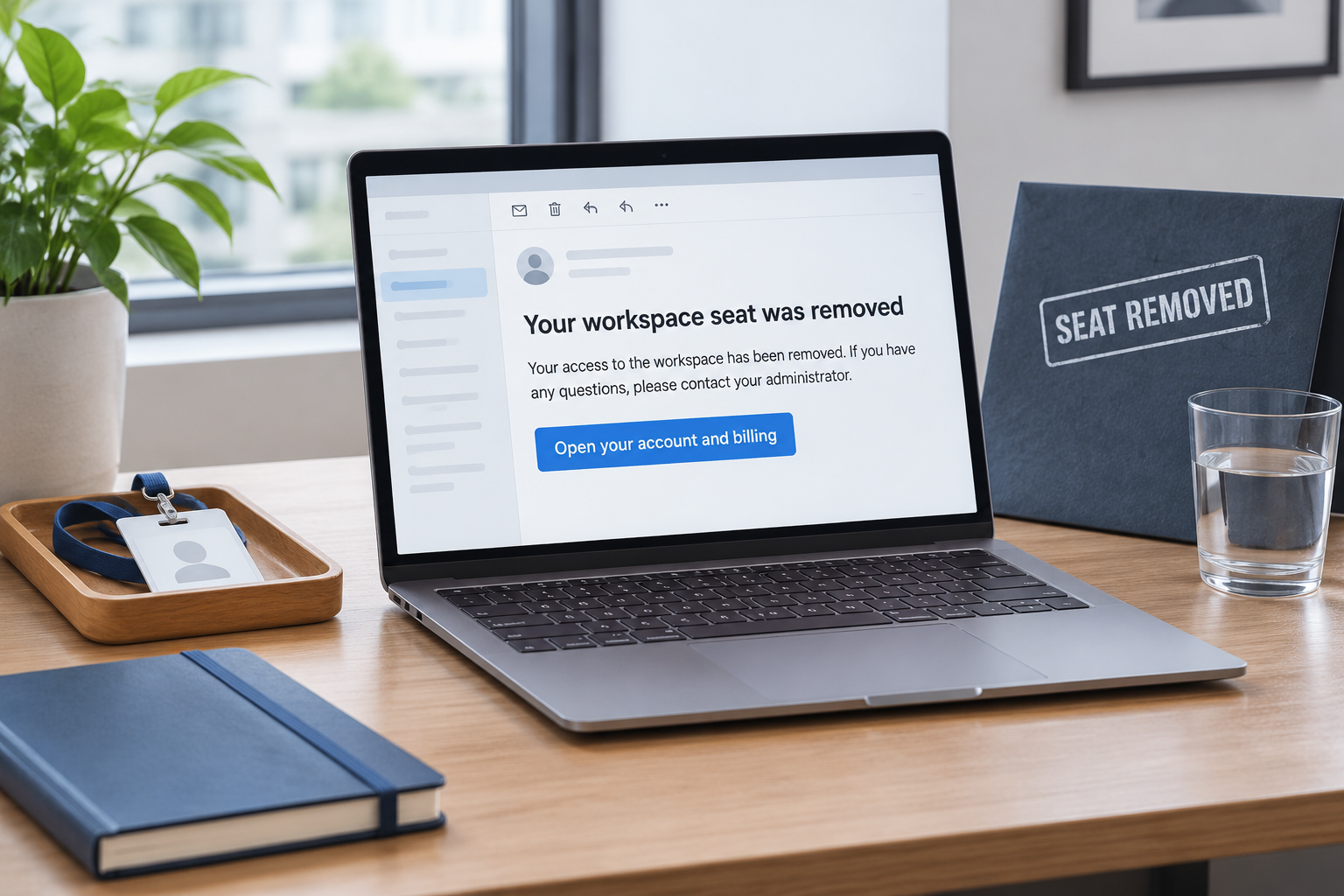
When a teammate’s workspace seat has already been removed in your own product — an unused license the billing admin already released, a departing contractor whose access you already ended, a workspace that dropped from five seats to four — that billing worker still has to tell the teammate: “Your workspace seat was removed,” plus an account / billing permalink they can still open. That send is transactional email. It is not a newsletter, not a marketing drip, and it is not a rewrite of the seat added, team role changed, invite accepted, plan downgraded, or membership expired guides. Those tutorials already exist, and they describe a seat being granted, a role changing inside a workspace the teammate can still enter, an invitation being accepted, a plan changing, or a membership running out. This article is one event in your own billing workflow: a workspace seat has already been removed. Rovela is not removing the seat — this is your app’s own workspace event, sent through POST /emails. The recipient is the teammate whose seat was removed (the address you already store on that seat). The call to action is “open your account and billing,” not “a seat was added,” not “your role changed,” and not “the workspace plan was downgraded.”
Point the permalink at a page the teammate can still open after the seat is gone: an account home or a billing portal you already provide. Do not link a workspace project page that would 403 now that they no longer have a seat. If they still have a personal account, that account page is the right destination. There is no client library to install. Use plain fetch plus curl when you want to prove the JSON. The JSON body and headers are the product. The billing worker that already recorded the removed seat should send the notice; Rovela does not manage workspace seats.
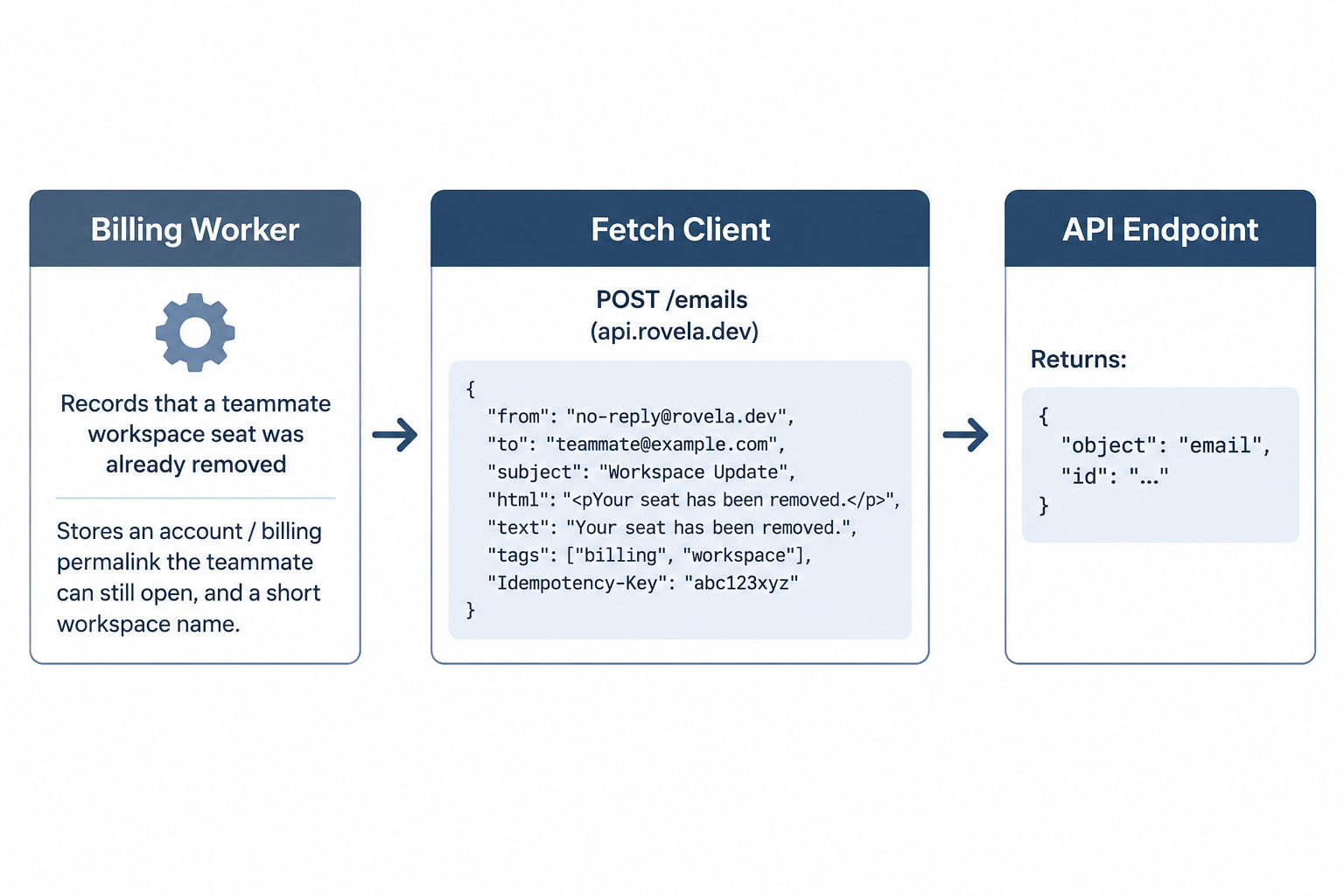
Rovela’s Email API is a single HTTPS call. The base URL is https://api.rovela.dev. You authenticate with Authorization: Bearer re_… (Authentication) and queue a message with POST /emails. The response is {"object":"email","id":"..."}. HTTP 200 means the message was accepted and queued, not that it has already arrived (Quick Start).
If you are still choosing between HTTP and SMTP, read Email API vs SMTP. Rovela’s SMTP is mailbox SMTP for mail apps (mx.rovela.dev:465, a device credential, send-as-self, 30 messages a minute from one client address). Programmatic volume from a billing worker belongs on POST /emails, which is also the distinction drawn in Email API vs SMTP relay.
What you need before the first seat-removed notice
The first-email guide and the Quick Start are the same five steps, whether the caller is curl or fetch inside a billing worker:
- Create an account. You start on the free plan, which sends real mail. There is no separate sandbox, and no test key that behaves differently from production.
- Add and verify a sending domain (a subdomain such as
mail.example.comis a common choice). You cannot send from a domain you have not verified; an unverified or foreignfromis refused with a 400 that names the domain. The dashboard asks for four DNS records — SPF, DKIM, DMARC, and return-path. See the domain setup guide, the Domains API, and what domain email is. - Create an API key. A
sending_accesskey can send and nothing else — the right default for a production seat notifier. Afull_accesskey can also read messages and events, and manage domains, templates, and webhooks. The full key is shown once. - Send with
POST /emails. - Confirm delivery in the dashboard, with
GET /emails/:idorGET /emails/:id/events(those reads needfull_accessor a dashboard session), or with a webhook.
from is a string in the documented form "Workspace <workspace@yourdomain.com>". The address must sit on a verified sending domain. That is the same rule that makes domain email trustworthy: you prove you control the domain before you speak as it. How the display name and the address work is covered in the From name guide and the sending domains API overview.
At least one of html, text, or template is required. Send both html and text where you can — many clients preview the text part, which is often where the teammate first sees the account / billing permalink (HTML email API).
A worker that sends after the seat is already removed
Keep the Rovela key out of the browser, out of a public repository, and out of a container image. A leaked sending_access key can send mail as your domain. The billing worker that already marked the seat removed should read ROVELA_API_KEY from its process environment and call Rovela only on the server (email API authentication). If an admin removes the seat from a settings screen, write your own seat record first (status removed, account / billing permalink already minted and reachable without that seat), then enqueue the notice. Do not call the Email API from a browser request, and do not invent a Rovela seats product — Rovela only sends the mail.
Store the event first: the seat id you already have, a short workspace name you already show on the account page, the teammate’s address, and the account / billing permalink they can still open. The send is just the notice. The recipient is consistently the teammate whose seat was removed — not every remaining admin, not a marketing segment, and not a shared operations inbox unless you add that address deliberately. Key the Idempotency-Key to that removed-seat event so a retried worker does not mail the same “your workspace seat was removed” notice twice. A later seat change for the same person (for example, they are added to a different workspace) is a different event and should be a different key. If an admin later adds a seat, that is the seat-added guide, not this one.
// rovela.js — billing-worker helper, plain fetch, no official SDK
const API = "https://api.rovela.dev";
function requireEnv(name) {
const value = process.env[name];
if (!value) throw new Error(`missing ${name}`);
return value;
}
export async function sendEmail({ to, subject, html, text, replyTo, tags, idempotencyKey }) {
const apiKey = requireEnv("ROVELA_API_KEY");
const from = requireEnv("ROVELA_FROM");
const body = { from, to, subject, html, text, tags };
if (replyTo) body.reply_to = replyTo;
const res = await fetch(`${API}/emails`, {
method: "POST",
headers: {
Authorization: `Bearer ${apiKey}`,
"Content-Type": "application/json",
"Idempotency-Key": idempotencyKey,
},
body: JSON.stringify(body),
});
const payload = await res.json().catch(() => ({}));
if (!res.ok) {
const err = new Error(payload.message || `rovela ${res.status}`);
err.statusCode = res.status;
err.name = payload.name;
throw err;
}
return payload.id;
}
function escapeHtml(value) {
return String(value)
.replaceAll("&", "&")
.replaceAll("<", "<")
.replaceAll(">", ">")
.replaceAll('"', """);
}
export async function notifySeatRemoved({
teammateEmail,
workspaceName,
accountBillingPermalink,
seatId,
}) {
const safeName = escapeHtml(workspaceName);
const safePermalink = escapeHtml(accountBillingPermalink);
const subject = `Your workspace seat was removed: ${workspaceName}`;
const text =
`Your seat in ${workspaceName} was removed.\n\n` +
`Open your account and billing: ${accountBillingPermalink}`;
const html =
`<p>Your seat in ${safeName} was removed.</p>` +
`<p><a href="${safePermalink}">Open your account and billing</a></p>`;
return sendEmail({
to: teammateEmail,
subject,
html,
text,
replyTo: process.env.ROVELA_REPLY_TO || undefined,
tags: { type: "seat_removed" },
idempotencyKey: `seat-removed-${seatId}`,
});
}
Call notifySeatRemoved from the billing worker that already wrote the removed-seat row — after the account / billing permalink exists and remains reachable without that seat, not before. A typical pattern is a worker that consumes your own “seat removed” event from a queue, or the final step of a seat-change job after it has recorded the removal. Keep the HTTP call out of the request path that merely opens the seats screen; the teammate should be mailed when the seat has actually been removed, not when an admin first clicks “manage seats.” The email is a status notice, not a place to dump an audit log or a list of projects they can no longer open. If a later decision restores the seat, that is a different event and should use a different idempotency key — do not reuse the seat-removed key, and do not silently overwrite the removed notice.
The same JSON can be sent with curl, which is useful in a staging shell while you confirm the verified from and the permalink:
curl -X POST https://api.rovela.dev/emails \
  -H "Authorization: Bearer $ROVELA_API_KEY" \
  -H "Content-Type: application/json" \
  -H "Idempotency-Key: seat-removed-seat_01H8Q2" \
  -d '{
    "from": "Workspace <workspace@yourdomain.com>",
    "to": "teammate@example.com",
    "subject": "Your workspace seat was removed: Acme Studio",
    "html": "<p>Your seat in Acme Studio was removed.</p><p><a href=\"https://app.example.com/account/billing\">Open your account and billing</a></p>",
    "text": "Your seat in Acme Studio was removed.\n\nOpen your account and billing: https://app.example.com/account/billing",
    "reply_to": "billing@yourdomain.com",
    "tags": {"type": "seat_removed"}
  }'
reply_to is documented and optional; use it when replies should reach a billing inbox rather than the sending address (reply-to). tags may be an object or an array of arbitrary labels — they are yours to choose, and they help you filter later in the dashboard or in webhooks (email API tags). headers and topic_id are also documented fields; this tutorial does not treat topic_id as a product tour. Attachments, if you ever add a short seat-change summary, use { filename, content (base64), content_type }. Do not attach identity documents, invoices for other teammates, or a full audit log. The permalink is the call to action (email attachments).
If you ever need to notify many independently removed seats in one go (an end-of-month license cleanup, not the usual single-seat path), POST /emails/batch accepts up to 100 messages, each with the same schema. Two fields are rejected rather than ignored: template and topic_id. Send those through POST /emails. See the batch example and the batch transactional email guide. Each item should still carry its own business key if you send them as individual POST /emails calls; if you use the batch endpoint, keep the rest of the payload identical to a single send, without template or topic_id.
template is documented as { id, variables } and is mutually exclusive with html and text. This tutorial sends both html and text so the teammate can open the account / billing permalink even in a text-only client. If you later switch a stable notice to a stored template, drop html and text and follow the Templates API, the templates guide, and the email templates API guide.
Idempotency, recipients, and what a 200 actually means
Billing workers retry, and a “the seat was removed, notify the teammate” path can run more than once for the same record. Send an Idempotency-Key header (up to 256 characters). A retry of the same request within 24 hours returns the original response instead of sending again (idempotency). Key it to the seat id (or to a specific removed-seat event id you already store), not to the clock and not to the teammate’s email alone. If the same person later has a different seat removed, that is a second notice and a second key.
A message may address at most 50 recipients across to, cc, and bcc combined. That is the transport’s limit, not a plan limit, and it is checked before the request is accepted. Quota is charged per recipient, not per message — cc and bcc count the same as to. A seat-removed notice addresses the teammate whose seat was removed. If a shared billing mailbox also has to be told, add that address deliberately and accept that it counts as a second recipient. Do not cc every remaining workspace admin by default.
HTTP 200 from POST /emails means the message was accepted and queued. It is not a delivery receipt. The JSON is {"object":"email","id":"..."}. Persist that id next to the seat record if you want to look the message up later from a dashboard session. Do not block the billing worker until a mailbox provider confirms delivery.
scheduled_at is a documented ISO 8601 future timestamp if you ever need to hold a notice. For a seat that is already removed, send immediately after the removed record is written. If you did schedule a message and the teammate should not receive it, POST /emails/:id/cancel cancels an unsent message. Reading, cancelling, and any rescheduling need full_access or a dashboard session. This article does not invent a reschedule request body.
Errors you should handle in the billing worker
Documented send errors use an envelope of { statusCode, name, message }:
- 400 — a missing required field, a
fromdomain that does not belong to your organization, atemplatethat does not exist, or more than 50 recipients on one message. Fix the payload; retrying the same body will fail the same way. - 401 — a missing, malformed, or revoked Bearer key. Check the process environment, not the seat row.
- 429 — you are being rate limited. Back off and retry with the same
Idempotency-Keyso a later attempt cannot send a second notice for the same seat (rate limits, retries).
Treat unknown 5xx responses as retryable with the same key. Log name and message next to the seat id; do not log the Bearer key. A practical walk-through is the email API error handling guide.
Delivery is asynchronous — do not poll from the worker
A 200 from POST /emails means accepted for delivery, not delivered. Reading GET /emails/:id or GET /emails/:id/events needs a full_access key or a dashboard session; a sending_access key cannot do it, and you should not add a polling loop inside the billing worker. Subscribe to a webhook instead, and verify the signature header x-resend-signature as documented in webhook security and signature verification. Event names include accepted, delivered, opened, clicked, bounced, or failed. For a single message you can also use the email delivery status API or the dashboard from a support session.
What not to do in this seat-removed notice
- Do not put the Rovela key in a browser client, a public repository, or a container image.
- Do not invent a Rovela seats product. Your worker already recorded that the seat was removed; Rovela delivers the mail. There is no official client library. Rovela is not removing the seat.
- Do not send this as a “seat added,” “team role changed,” “invite accepted,” “plan downgraded,” or “membership expired” template borrowed from another tutorial. The permalink is an account or billing page the teammate can still open, and the recipient is the teammate whose seat was removed.
- Do not include a workspace project URL that would 403 after the seat is gone, an audit-log dump, or other teammates’ billing details in the email body. The notice carries a short workspace name and a reachable permalink.
- Do not send from mailbox SMTP for this. SMTP is for mail apps and mailboxes. A billing worker should use the HTTP API. Inbound mail into a hosted mailbox is a different path, described in the webmail manual; this guide is an outbound seat-removed notice.
- Do not poll
GET /emails/:idwith asending_accesskey, and do not invent a reschedule body if you later cancel an unsent message.
A compact seat-removed checklist
- Verify the sending domain and create a
sending_accesskey (Quick Start). - Put
ROVELA_API_KEYandROVELA_FROMin the billing worker’s process environment, not in the browser. - Record the removed seat first: teammate address, workspace name, and an account / billing permalink the teammate can still open.
- Call
POST /emailswithfetch(or curl), bothhtmlandtext, areply_toif you want replies in a billing inbox, and anIdempotency-Keyscoped to that seat id. - Treat HTTP 200 as accepted, not delivered. Persist the returned message id if you need it later.
- Confirm delivery with a signed webhook or from the dashboard.
- If you are comparing providers, the existing pages are Rovela vs Mailgun, vs Amazon SES, vs Postmark, vs SendGrid, vs Resend, and vs Brevo. For the HTTP shape itself, see the transactional email API, the curl sending guide, and the HTTP email API overview. For other notification patterns, see the email notification API guide.