Azure Functions Transactional Email API (2026): Send a Refund Notice from an HTTP Trigger with POST /emails
Send transactional email from an on-demand Azure Functions v4 HTTP trigger with Rovela’s HTTP API: application settings for the Bearer key, a refund-processed notice, and Idempotency-Key. Distinct from the Azure Functions timer/cron guide.
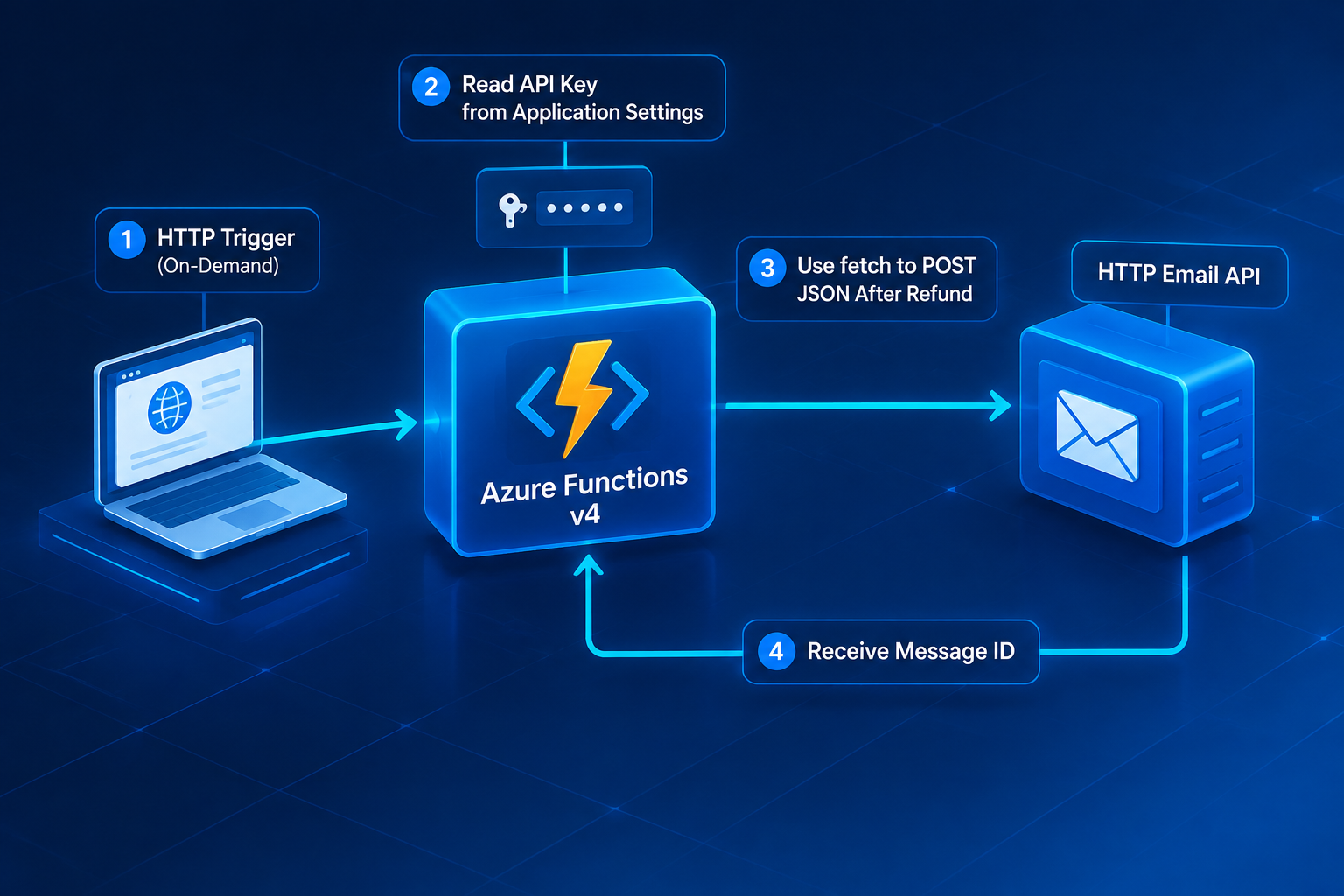
Azure Functions already isolate HTTP work; transactional email belongs in the trigger, not the timer
An Azure Function can fire because a clock ticked or because someone called it. Those are different product problems. The timer trigger guide already covers the cron case. This article is the on-demand case: an HTTP trigger that sends after your billing service has processed a refund. Transactional email — “your refund has been processed,” a credit that just landed, a receipt of money going back — is request-shaped work. The natural way to send it is one HTTPS POST with a Bearer key from the function, not mailbox SMTP, and not a timer that polls for refunds.
Rovela’s Email API is built for that. There is no client library to install and no official Azure Functions binding you have to pin. The base URL is https://api.rovela.dev. You authenticate with Authorization: Bearer re_… (Authentication) and queue a message with POST /emails. The response is a message id. HTTP 200 means the message was accepted and queued, not that it has already arrived (Quick Start).
This is not a redo of a one-time passcode tutorial, and it is not a rewrite of the Lambda, Netlify, or Google Cloud Functions guides in this cluster. The AWS Lambda transactional email article sends a payment receipt. The Netlify Functions transactional email article opens a support ticket. The Google Cloud Functions transactional email article tells a creator a video is ready. Here the runtime is Azure Functions v4, the trigger is HTTP, and the story is “your refund has been processed.”
If you are still choosing between HTTP and SMTP, read Email API vs SMTP. Rovela’s SMTP is mailbox SMTP for mail apps (mx.rovela.dev:465, a device credential, send-as-self, 30 messages a minute from one client address). Programmatic volume from an Azure Function belongs on POST /emails.
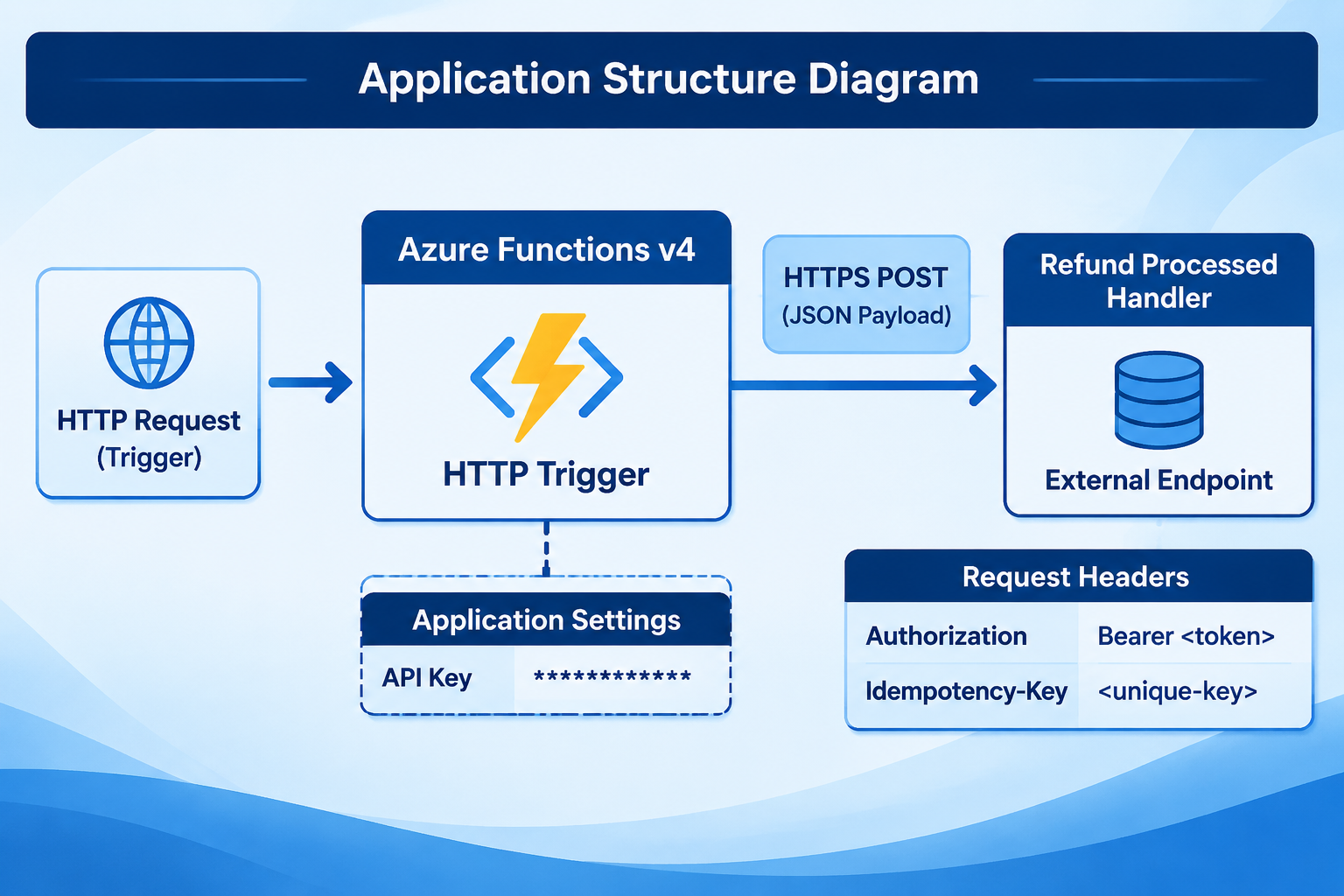
What you need before the first Azure Functions send
The first-email guide and the Quick Start are the same five steps, whether your caller is curl or fetch inside a function:
- Create an account. You start on the free plan, which sends real mail. There is no separate sandbox or test key.
- Add and verify a sending domain (a subdomain such as
mail.example.comis a common choice). You cannot send from a domain you have not verified; an unverified or foreignfromis refused with a 400 that names the domain. See the domain setup guide and what domain email is. - Create an API key. A
sending_accesskey can send and nothing else — the right default for production. Afull_accesskey can also read messages and events, and manage domains, templates, and webhooks. The full key is shown once. - Send with
POST /emails. - Confirm delivery in the dashboard, with
GET /emails/:idorGET /emails/:id/events(those reads needfull_accessor a dashboard session), or with a webhook.
from is a string in the documented form "Billing <refunds@yourdomain.com>". The address must sit on a verified sending domain. That is the same rule that makes domain email trustworthy: you prove you control the domain before you speak as it. How the display name and the address work is covered in the From name guide.
At least one of html, text, or template is required. Send both html and text where you can — many clients preview the text part (HTML email API).
Application settings and a small send helper
Keep the key out of the source tree. In Azure Functions, private values belong in application settings (or Key Vault references), which the runtime exposes as process.env. Never put a Rovela key in a static web app, a frontend bundle, or a repository. A leaked sending_access key can send mail as your domain.
# Application settings (server only; never commit the live key)
ROVELA_API_KEY=re_your_sending_key
ROVELA_FROM=Billing <refunds@mail.example.com>
The helper below uses the platform fetch already available in a current Node runtime, so the function does not need a second HTTP client just to send mail. The JSON body and headers are the same ones the Emails API documents.
// src/emails.ts
function requireEnv(name: string): string {
  const value = process.env[name]
  if (!value) {
    throw new Error(`Missing required environment variable: ${name}`)
  }
  return value
}

const ROVELA_API_KEY = requireEnv('ROVELA_API_KEY')
const ROVELA_FROM = requireEnv('ROVELA_FROM')

export class ApiError extends Error {
  statusCode: number
  override name: string
  constructor({ statusCode, name, message }: { statusCode: number; name?: string; message?: string }) {
    super(message || `Rovela: HTTP ${statusCode}`)
    this.statusCode = statusCode
    this.name = name || 'ApiError'
  }
}

export async function sendEmail(input: {
  to: string | string[]
  subject: string
  html?: string
  text?: string
  replyTo?: string | string[]
  tags?: Record<string, string> | Array<{ name: string; value: string }>
  idempotencyKey?: string
}) {
  const headers: Record<string, string> = {
    Authorization: `Bearer ${ROVELA_API_KEY}`,
    'Content-Type': 'application/json',
  }
  if (input.idempotencyKey) {
    headers['Idempotency-Key'] = input.idempotencyKey
  }

  const body: Record<string, unknown> = {
    from: ROVELA_FROM,
    to: input.to,
    subject: input.subject,
  }
  if (input.html) body.html = input.html
  if (input.text) body.text = input.text
  if (input.replyTo) body.reply_to = input.replyTo
  if (input.tags) body.tags = input.tags

  const res = await fetch('https://api.rovela.dev/emails', {
    method: 'POST',
    headers,
    body: JSON.stringify(body),
  })

  const payload = await res.json().catch(() => ({}))
  if (!res.ok) {
    throw new ApiError({
      statusCode: Number(payload.statusCode || res.status),
      name: payload.name,
      message: payload.message,
    })
  }
  return payload as { object: string; id: string }
}
An HTTP trigger that sends after a refund is processed
A refund that just cleared is a good everyday example because it is not a login code and it is easy to double-send: the billing worker retries, Service Bus redelivers, an operator replays the HTTP call. Put the send behind a Functions v4 HTTP trigger, and give every refund a stable Idempotency-Key. An Idempotency-Key may be up to 256 characters; a retry of the same request within 24 hours returns the original response instead of sending again.
// src/functions/refundProcessed.ts
import { app, HttpRequest, HttpResponseInit, InvocationContext } from '@azure/functions'
import { ApiError, sendEmail } from '../emails'

export async function refundProcessed(
  request: HttpRequest,
  context: InvocationContext,
): Promise<HttpResponseInit> {
  const payload = (await request.json().catch(() => ({}))) as Record<string, unknown>
  const refund = await recordProcessedRefund(payload)
  if (!refund?.id || !refund.customerEmail) {
    return { status: 400, jsonBody: { error: 'Missing refund payload' } }
  }

  const amount = formatMoney(refund.amount, refund.currency)

  try {
    const result = await sendEmail({
      to: refund.customerEmail,
      subject: 'Your refund has been processed',
      html: `<p>A refund of ${amount} for order ${refund.orderNumber} has been processed.</p><p>It should appear on the original payment method shortly.</p>`,
      text: `A refund of ${amount} for order ${refund.orderNumber} has been processed. It should appear on the original payment method shortly.`,
      tags: { purpose: 'refund-processed', refund_id: refund.id },
      idempotencyKey: `refund-processed:${refund.id}`,
    })
    return { jsonBody: { ok: true, emailId: result.id } }
  } catch (err) {
    if (err instanceof ApiError) {
      context.error(err.message)
      return { status: 502, jsonBody: { error: err.message, statusCode: err.statusCode } }
    }
    throw err
  }
}

app.http('refundProcessed', {
  methods: ['POST'],
  authLevel: 'function',
  handler: refundProcessed,
})
authLevel: 'function' requires a function key on the request. That is a start, not the whole story — you still want the call to come from your billing worker, not from a public form. The Emails API is called from your Azure Function, not from the browser. A dashboard button should POST to your function only if that path is already authenticated; it must never call api.rovela.dev with a key the client can see.
recordProcessedRefund and formatMoney are your domain code. This article does not invent a Rovela refunds endpoint — Rovela accepts the message you already decided to send.
If you later need many personalized messages in one go, use batch (POST /emails/batch, up to 100 messages, each processed independently). template and topic_id are rejected on batch rather than ignored; send those through POST /emails.
Errors you should handle in the function
Every documented error uses the same envelope, so one ApiError covers them (Quick Start, Email API error handling):
{ "statusCode": 400, "name": "Bad Request", "message": "html or text body is required" }
The message says what was wrong. Surface it in your own logs as-is.
400— a missing required field, a base64 attachment that does not decode, afromdomain that does not belong to your organization, atemplatethat does not exist, or more than 50 recipients on one message.401— missing or invalid credential, or asending_accesskey used to read, reschedule, or cancel a message.429— rate limit exceeded. The first-email guide notes that the rate limit is per key, and that each message in a batch counts individually. The official batch example waits onRetry-Afterwhen that header is present (and falls back to one second if it is not). This article will not invent a requests-per-second number, because the public docs do not publish one.
HTTP 200 on send is not delivery. If you need to look a message up later, GET /emails/:id and GET /emails/:id/events require a full_access key or a dashboard session — do not put that key in the same function you call from every refund. Managing sending domains is a different API and a different key scope (Domains API, Email API authentication, sending domains API). A sending_access key used on a management endpoint such as GET /domains is documented as 403; that is not the same as a failed send.
Delivery is asynchronous — do not poll from the trigger
The function should record the message id and return. Confirm delivery in the dashboard, with the Email delivery status API, or with a webhook. For production, prefer a webhook over polling GET /emails/:id from the request path.
A webhook endpoint can be a second HTTP trigger that reads the raw body, verifies x-resend-signature, and returns 2xx quickly. Verification is byte-exact HMAC-SHA256 over "<timestamp>.<raw body>" (webhook security). A 400 you return because a payload surprised you is a permanent loss; store anything you do not yet understand rather than rejecting it. Deduplicate on the event id. Managing webhook endpoints themselves is covered in the Email Webhooks API guide.
When you need a message to go out later, use scheduled_at (scheduled email). POST /emails/:id/cancel can cancel a message that has not been sent yet; reading, rescheduling, and cancelling need a full_access key or a dashboard session. Public docs do not describe a reschedule request body, so this article will not invent one. When you need many sends in one request, use batch transactional email. Reusable layouts belong in the Templates API and the templates guide.
What not to do in an Azure Function
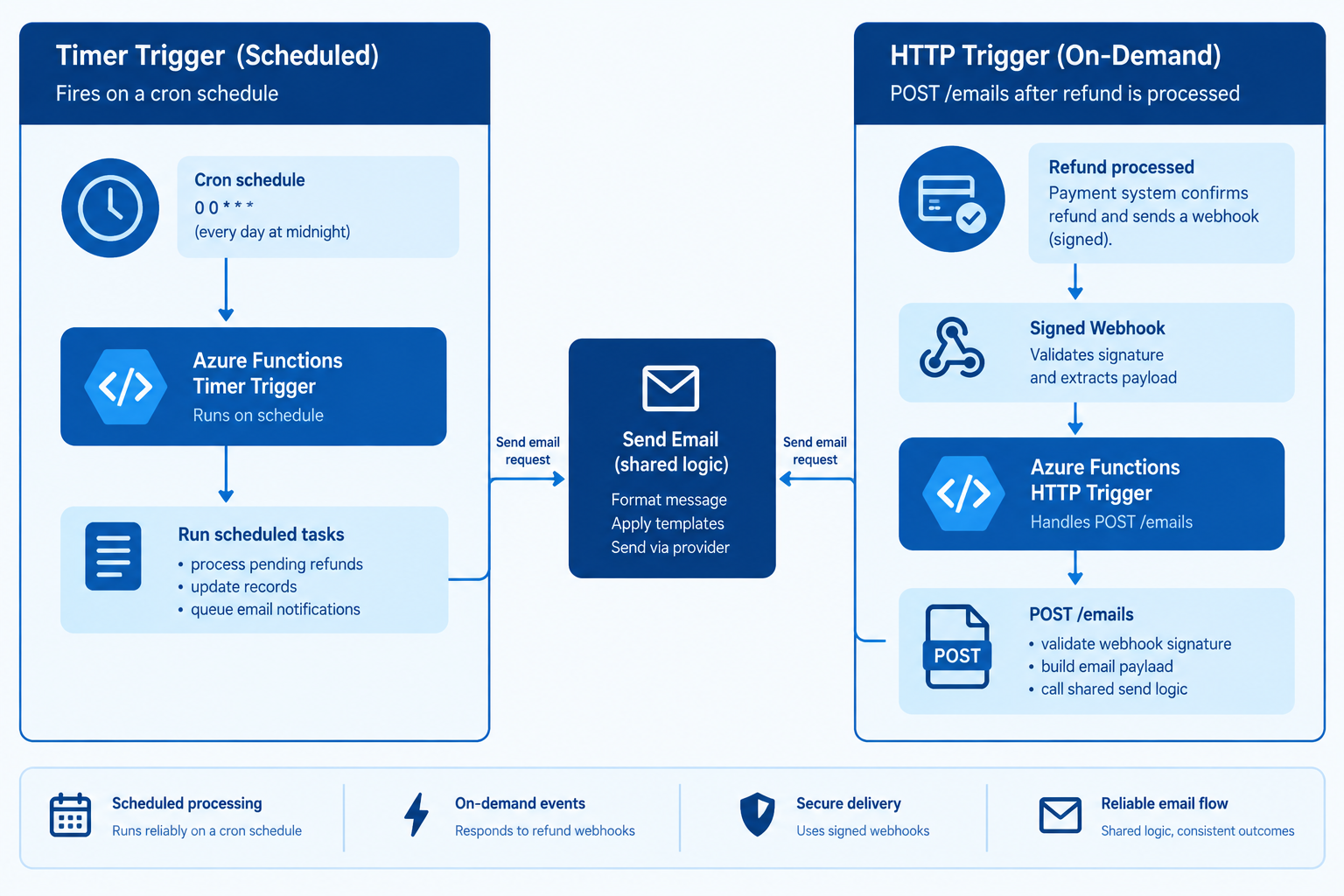
Do not turn this into a timer article. If you need a cron-shaped send on Azure, start from Azure Functions timer email. This function exists because a refund was processed, not because a schedule fired.
Do not point Nodemailer or any other SMTP client at Rovela mailbox SMTP and call that your application mailer. Mailbox SMTP is for mail apps: a mailbox can send only as itself, and a single client address is limited to 30 messages a minute. That is the wrong default for app volume, which is the point of Email API vs SMTP relay as well.
Do not put a Rovela key in a public asset, a static web app, or a repository. Call the API from the function. Authentication is explicit: a browser bundle is readable by anyone who has it.
Do not treat this guide as a replacement for an OTP article, and do not treat it as a Lambda, Netlify, or Cloud Functions rewrite. Those guides have their own stories and secret stores. This one notifies a customer that a refund has been processed, from an Azure Functions v4 HTTP trigger.
Hosted mailboxes are a different product surface. People can read and send from them in a mail app. Your function should not share a device credential with someone else’s Thunderbird profile.
If you send on behalf of several customers from one organization, restrict a key to a single domain so a leak cannot send as somebody else (Email API for multi-tenant SaaS). Retries of a failed HTTP call should reuse the same idempotency key (Email API retries).
If you later compare providers, the documented pages include Rovela vs Resend, vs SendGrid, vs Postmark, vs Mailgun, vs Brevo, and vs Amazon SES.
A compact Azure Functions checklist
- Verify the sending domain before you set
from. An unverified domain is a 400, not a silent drop. - Keep
ROVELAcredentials in application settings or Key Vault, never in the repo or a client app. - Prefer a
sending_accesskey in the production HTTP trigger; keepfull_accessfor tooling that reads events or manages webhooks. - Send both
htmlandtextwhen you can, and set anIdempotency-Keyon any path a retry can hit twice. - Record the message
idand return from the function. Watch delivery with a webhook, not a loop on the request path. - If you need a first request in curl, use the transactional email API overview, the curl sending guide, or the HTTP email API explainer — then come back to this trigger for the Azure Functions shape.