Framer Transactional Email API (2026): Send a Membership Magic-Link Sign-In with POST /emails
After your Framer membership site already mints a one-time sign-in URL, send that magic link with Rovela POST /emails. No official Framer plugin. Rovela does not authenticate Framer members.
A Framer membership magic link is not a Webflow form receipt, a generic magic-login primer, or a CMS unpublish warning
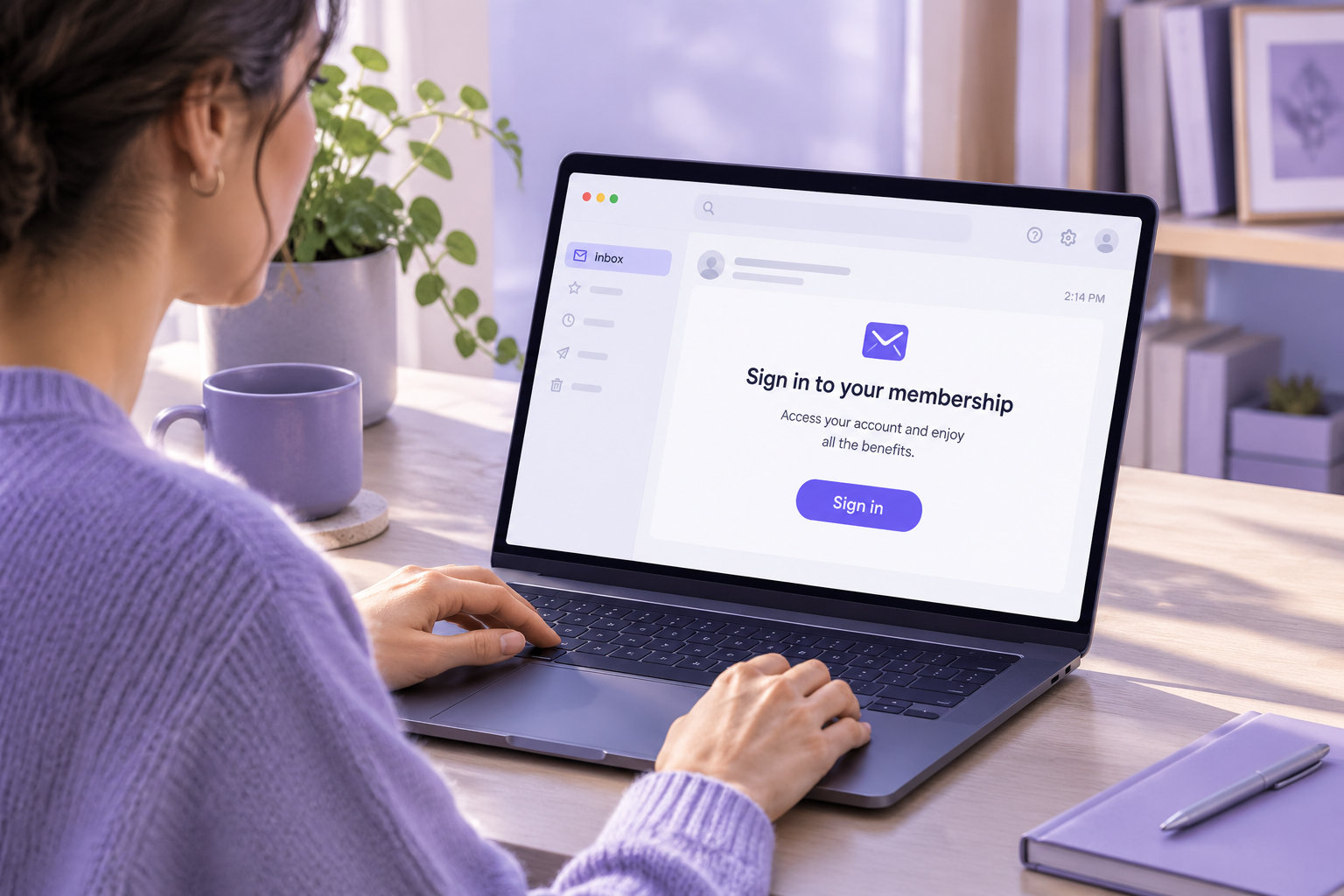
When a Framer site already has membership enabled — a gated page, a “sign in” form, and a one-time sign-in URL you minted after the member typed their address — the backend or webhook receiver behind that site still has to tell the member: “Sign in to your membership,” plus the magic URL you already have. That send is transactional email. It is not a campaign, and it is not a rewrite of the Webflow form-submission confirmation, the generic magic login email links primer, or a CMS unpublish warning. Those tutorials already exist. Webflow’s article confirms to a submitter that a form was received. This article is a Framer member asking to sign in, after your own membership record and one-time URL already exist. Rovela does not run Framer, issue membership cookies, or talk to Framer’s builder — this is your site’s own membership magic-link event, sent through POST /emails. The recipient is the address that was just submitted. The call to action is “sign in,” not “we received your form,” and not “confirm this email to create an account” unless that is a separate event with a separate token.
This guide does not invent an official Framer plugin or a Rovela Framer SDK. There is no client library to install. Framer’s canvas and CMS live in the browser; the key must live in your server, serverless function, or membership webhook receiver. Send from a domain you verified, with DKIM and an Idempotency-Key.
If you also notify a site owner that a contact form arrived, that is a different event (owner, not member) and should use a different Idempotency-Key. Keep membership sign-in on its own path.
What you need before the first membership magic-link sign-in
The first-email guide and the Quick Start are the same five steps, whether you call curl or a server-side fetch from the server or webhook receiver behind your Framer membership site:
- Create an account. The free plan sends real mail. There is no separate sandbox, and no test key that behaves differently from production.
- Add and verify a sending domain (often a subdomain such as
mail.example.com). An unverified or foreignfromis refused with a 400 that names the domain. The dashboard asks for four DNS records — SPF, DKIM, DMARC, and return-path. See the domain setup guide, the Domains API, and what an email domain is. - Create an API key. A
sending_accesskey can send and nothing else — the right default for a production membership magic-link sign-in sender. Afull_accesskey can also read messages and events, and manage domains, templates, and webhooks. The full key is shown once. Keys look likere_…and go out as a bearer token (authentication, email API authentication). - Send with
POST /emails. - Confirm delivery in the dashboard, with
GET /emails/:idorGET /emails/:id/events(those reads needfull_accessor a dashboard session), or with a webhook.
from is a string in the documented form "Studio <login@mail.example.com>". The address must sit on a verified sending domain. You prove you control the domain — that is what makes domain email trustworthy — before you speak as it. See the From name guide, the sending domains API, how email authentication works, how to set up domain email, and sending subdomain setup.
At least one of html, text, or template is required. template is a documented { id, variables } object and is mutually exclusive with html and text. Send both html and text where you can (HTML email API). Reusable copy can move to a template later; follow the templates guide. Examples here keep the copy inline.
Programmatic volume belongs on the HTTP email API, not on mailbox SMTP. Rovela SMTP is mailbox mail for Outlook, Apple Mail, or a phone: host mx.rovela.dev, port 465 with SSL/TLS, the mailbox’s full address, and a device credential (the same one that device uses for IMAP). A mailbox can send only as itself. For this membership magic-link sign-in, start with email API vs SMTP.
A Framer membership backend that sends only after the one-time sign-in URL already exists
Framer sites often need a small backend for membership because the published canvas should not hold a sending key. That backend can be a Route Handler you already host, a serverless function, or a receiver that Framer can call after a membership form. Collect the address on the Framer form, POST it to your backend, and send from there.
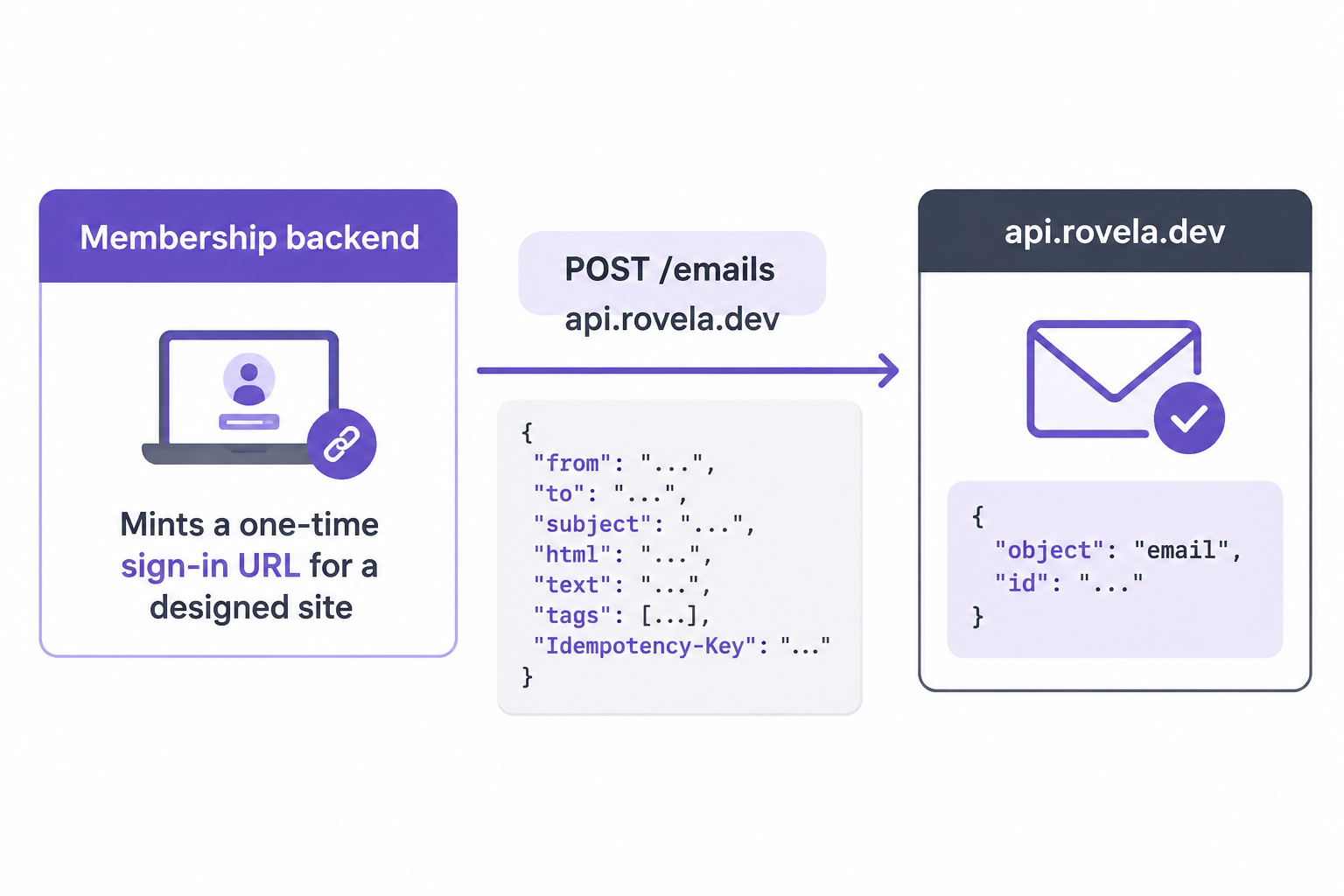
Do the membership work first, then the send. Look up the member (or the pending membership row), mint a one-time token, store only its hash and an expiry you enforce, and build a sign-in URL such as https://www.example.com/members/magic?token=…. Only after that write succeeds should you call the Send Email API.
There is no official Framer SDK for Rovela. A server-side fetch is enough:
// Membership backend — not a Framer canvas code override that ships to the browser.
const signInUrl = `https://www.example.com/members/magic?token=${plainToken}`;

const res = await fetch("https://api.rovela.dev/emails", {
  method: "POST",
  headers: {
    Authorization: `Bearer ${process.env.ROVELA_API_KEY}`,
    "Content-Type": "application/json",
    "Idempotency-Key": `framer-member-login-${memberId}-v${tokenVersion}`,
  },
  body: JSON.stringify({
    from: "Studio <login@mail.example.com>",
    to: email,
    subject: "Sign in to your membership",
    html:
      `<p>Use this link to sign in to your membership. It expires in 15 minutes.</p>` +
      `<p><a href="${signInUrl}">Sign in</a></p>` +
      `<p>If you did not request this, you can ignore this message.</p>`,
    text:
      `Use this link to sign in to your membership. It expires in 15 minutes.\n${signInUrl}\n` +
      `If you did not request this, you can ignore this message.`,
    tags: { type: "membership-magic-login", source: "framer-site" },
  }),
});

if (!res.ok) {
  const err = await res.json().catch(() => ({}));
  throw new Error(`rovela ${res.status}: ${err.message || res.statusText}`);
}

const { id } = await res.json();
Use a sending_access key. Your /members/magic page verifies the token and starts the membership session. Rovela does not set Framer cookies. Put both html and text in the request so a phone preview still shows the link.
Idempotency, recipients, and what a 200 actually means
Retries are normal. A server action, edge function, workflow, or queued job can time out after Rovela has already accepted the message. Send the documented Idempotency-Key header so a retry does not create a second membership magic-link sign-in. A stable key such as framer-member-login-user_17-v2 is unique to this event, this recipient, and this token or invite version, and it stays the same when the HTTP call is repeated.
to accepts a string or an array. cc and bcc count toward billing and toward the documented cap of 50 recipients on one message. For a membership magic-link sign-in, use a single to: the member who just asked to sign in. If you need an owner copy, send a second, separately idempotent message instead of BCC-ing a shared inbox.
A 200 from POST /emails means accepted for delivery, not arrived. The body looks like {"object": "email", "id": "9f1c2e40-..."}. Delivery is asynchronous. Read state with GET /emails/:id or GET /emails/:id/events (those need full_access or a dashboard session). In production, subscribe to a webhook for email.sent, email.delivered, email.bounced, and related events instead of polling from the request that minted the membership magic-link sign-in.
If the address is on the suppression list, the send can still return an id, but the message is not delivered and its status becomes suppressed. Check Suppressions in the dashboard before assuming the API failed. Rate limits are per key; a 429 means retry with backoff. Each message in a POST /emails/batch request counts individually.
Optional documented fields include reply_to, scheduled_at (an ISO 8601 timestamp in the future), tags, headers, and attachments as { filename, content (base64), content_type }. This membership magic-link sign-in does not need an attachment. To queue a later follow-up, use scheduled_at — not a sleep in the request path. A batch is appropriate only when you truly have many different messages, up to 100 per request.
Errors you should handle in the Framer membership backend
Documented errors share one shape: statusCode, name, and message. Handle them once in the Framer membership backend.
- 400 — a missing required field, a
fromdomain that is not in your organization or is still unverified, a template that does not exist, a base64 attachment that does not decode, or more than 50 recipients on one message. Readmessage; it often names the domain or the missing field. Do not retry a 400 in a tight loop. - 401 — missing or invalid credential, or a missing
Bearerprefix. A revoked key looks the same from the client’s point of view. - 403 — a valid
sending_accesskey used on a management or read endpoint such asGET /emails/:idorGET /domains. The message says which permission is required. Keep the send path onsending_access; usefull_accessor the dashboard for status reads. - 429 — the per-key rate limit. Retry with backoff. Do not fan out a burst of membership magic-link sign-in sends from an unqueued loop.
A leaked sending_access key can send mail as your domain. Keep ROVELA_API_KEY in the server or edge-function environment, never in the browser, a mobile client, a public page, or a chat transcript (email API authentication). There is no official client SDK to install; a standard HTTPS call is enough.
Delivery is asynchronous — do not poll from the Framer membership backend
After membership magic-link sign-in is accepted, delivery continues in the background. The Framer membership backend should store the returned message id next to your own event record and return to the user. Watching the message from that same request with a tight GET /emails/:id loop will slow the sign-up, invite, or form path and still needs full_access.
For production, configure a webhook and follow the webhook overview. Typical events include email.sent, email.delivered, email.opened, email.clicked, and email.bounced (event reference). Use bounces to keep your own list clean; do not invent a /logs API — the documented reads are GET /emails/:id, GET /emails/:id/events, the dashboard Emails view, and webhooks.
If a membership magic-link sign-in landed in spam, start with DNS rather than the HTTP call: confirm the DKIM record is published at the selector the dashboard gave you, that you have exactly one SPF record, and that DMARC is not p=reject on a brand-new domain with no sending history. Reputation takes weeks, not minutes (how email authentication works).
What not to do in this Framer membership magic link
Do not drop a Rovela key into a Framer code override, a CMS field, or a page that ships to visitors. Do not send membership links through mailbox SMTP. Use the HTTP API.
Do not reuse the Webflow form confirmation copy for this event. Do not invent a Framer marketplace app or a sandbox key. Do not poll GET /emails/:id from the sign-in request. Rotate the Idempotency-Key when you mint a new token.
Rovela will not unlock the gated page. Your membership route does that after a successful click.
A compact Framer membership magic-link checklist
- Verify a sending domain and create a
sending_accesskey (Quick Start). - Mint the one-time membership sign-in URL on your backend first.
- Call
POST /emailsfrom that backend withIdempotency-Key,html, andtext. - Keep the key off the Framer canvas and out of the published site.
- Use webhooks for bounces; a 200 only means accepted.
- Invalidate the token after a successful sign-in.