RQ Scheduler Transactional Email with Rovela (2026): cron + Idempotency-Key per Window
Wire Python RQ Scheduler cron jobs to Rovela POST /emails with server-only sending_access and a window-scoped Idempotency-Key for digests and ops reports.
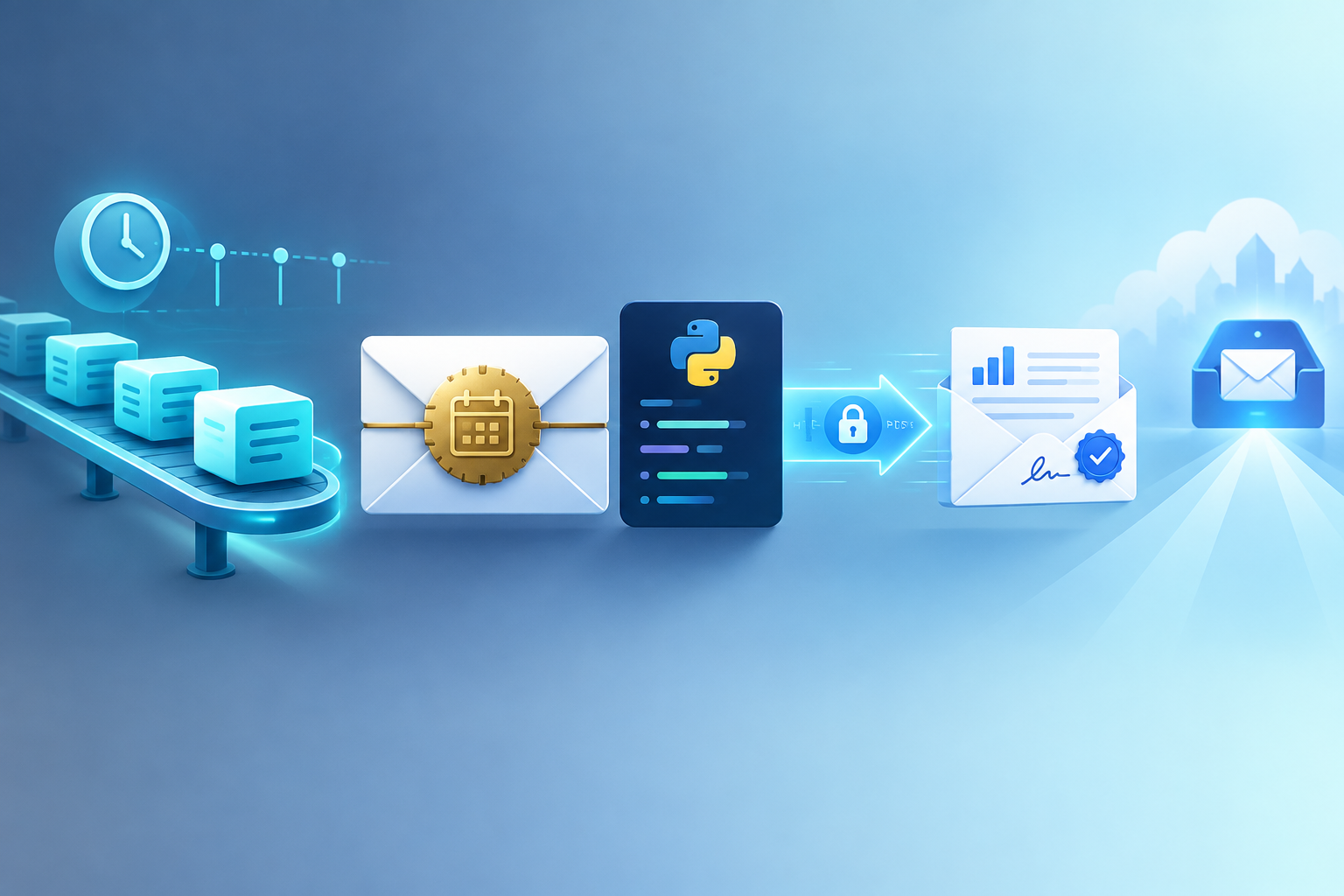
RQ Scheduler owns the schedule — Rovela delivers the mail
RQ Scheduler adds cron and delayed scheduling on top of RQ (Redis Queue). You call scheduler.cron(...) (or manage jobs via the scheduler CLI), run an rqscheduler process plus rq worker processes, and Redis holds both queues and schedule state. That fits digests whose body depends on live DB state at fire time.
Distinct from APScheduler Cron Email (in-process) and Celery Beat Transactional Email — this post is RQ + rq-scheduler.
Rovela queues, DKIM-signs, and delivers when your job method calls POST https://api.rovela.dev/emails (Send Email API, Quick Start, Authentication). RQ Scheduler owns the cadence and “is due?” logic. Your job method owns aggregation, secrets for sending_access, and a stable Idempotency-Key per schedule window. Rovela only delivers.
This guide wires RQ Scheduler → job method → Rovela that:
- Declares
scheduler.cron("0 9 * * *", func=send_daily_digest, id="daily-digest-email", queue_name="mailers")and runsrqscheduler+ workers - Keeps
ROVELA_API_KEY(sending_access),MAIL_FROM, and recipients in server-only config — never in browsers, SPA bundles, or a public Git tree - Aggregates a digest / report for the current schedule window inside the job method
- Sends via Rovela with a window-scoped
Idempotency-Key - Survives retries, restarts, and multi-worker fleets without duplicate mail
Rovela does not create RQ Scheduler schedules, workers, or storage. RQ Scheduler owns schedule → enqueue/fire → execute. Your job method owns query → map fields → POST /emails. Rovela owns delivery.
Distinct from:
- Quartz Scheduler Transactional Email — Java Quartz
- node-cron Transactional Email — node-cron
- NestJS Schedule Cron Email — NestJS @Cron
- Laravel Task Scheduler Email — Laravel Schedule::
- APScheduler Cron Email — APScheduler
- Spring @Scheduled Email — Spring @Scheduled
- Resque-scheduler Email — Resque-scheduler
- delayed_job Recurring Email — delayed_job
- Solid Queue Recurring Email — Solid Queue
- Hangfire Recurring Jobs Email — Hangfire
- Sidekiq-Cron Transactional Email — Sidekiq-Cron
- Celery Beat Transactional Email — Celery Beat
- Agenda.js Scheduled Jobs Email — agenda
- BullMQ Repeatable Email — BullMQ
- Temporal Schedule Email — Temporal
- Trigger.dev Cron Email — Trigger.dev
- Inngest Cron Transactional Email — Inngest
- Kubernetes CronJob Email — K8s CronJob
- Vercel Cron Digest Email — Vercel cron
- Scheduled Email Sending — scheduled_at
Also distinct from platform cron that curls an HTTP route — RQ keeps work inside your Redis-backed workers.
What RQ Scheduler schedules vs what Rovela sends
| Concern | Owner |
|---|---|
| cron expression, job id, queue | RQ Scheduler (rqscheduler) |
| Redis broker + RQ workers | RQ |
| Job function execution | Your Python function / job |
Server secrets for ROVELA_API_KEY (sending_access) | Process / worker env / secret store |
| Query DB / APIs for the window | Your job method |
| Render HTML + text | Your job method |
POST /emails, DKIM, queue, bounces | Rovela |
Idempotency-Key = rq-scheduler-daily-digest:{yyyy-mm-dd} | Your job method |
A 200 from Rovela means accepted and queued, not “already in the inbox” (Quick Start).
RQ Scheduler constraints that shape the email job
-
Run one
rqschedulerprocess (HA carefully) — multiple schedulers can double-enqueue. -
Workers must listen on the same queue the cron targets.
-
Job functions must be importable by workers (module path stability).
-
Keep
ROVELA_API_KEYin worker env, not in Redis job kwargs if avoidable. -
Prefer Celery Beat when you already run Celery; prefer APScheduler when you want no Redis.
-
Keep
sending_accessserver-only. StoreROVELA_API_KEYin environment / vault — never in client apps or public Git (Authentication). -
Prefer HTTPS
POST /emails. Outbound SMTP from a worker is a poor fit (Email API vs SMTP).
When to use RQ Scheduler + POST /emails (not scheduled_at)
Use RQ Scheduler → live send when:
- The HTML must include fresh metrics at fire time
- You already run RQ Scheduler and want schedules next to the same workers
- You need cron-like digests without adopting a separate SaaS scheduler
- One (or a few) transactional messages go to ops / founder / customer addresses looked up at run time
Use Rovela scheduled_at when the body is already correct and you only need “deliver later” without a running scheduler (Scheduled Email Sending). Prefer RQ Scheduler when Redis+RQ is already your queue; prefer Celery Beat for Celery stacks.
Prerequisites
- A verified sending domain in Rovela. Unverified
fromdomains are refused with400(Quick Start). - An API key shaped like
re_…. Prefersending_accessfor the worker (Authentication). - Python app with
rq,rq-scheduler, Redis, onerqscheduler, and RQ workers. - Config:
ROVELA_API_KEY,MAIL_FROM,DIGEST_TO. - Importable job functions and Redis URL config.
Register the schedule
pip install rq rq-scheduler
# schedule_boot.py — run once at deploy / in a management command
from redis import Redis
from rq_scheduler import Scheduler
from jobs.digest import send_daily_digest, send_ops_pulse

scheduler = Scheduler(queue_name="mailers", connection=Redis.from_url("redis://localhost:6379/0"))
# cancel prior ids if re-registering
for job_id in ("daily-digest-email", "ops-pulse-email"):
    if scheduler.__contains__(job_id):  # or scheduler.cancel(job_id)
        try:
            scheduler.cancel(job_id)
        except Exception:
            pass

scheduler.cron(
    "0 9 * * *",
    func=send_daily_digest,
    id="daily-digest-email",
    queue_name="mailers",
    use_local_timezone=False,  # prefer UTC semantics; confirm version API
)
scheduler.cron(
    "*/15 * * * *",
    func=send_ops_pulse,
    id="ops-pulse-email",
    queue_name="mailers",
)
# one scheduler + workers
rqscheduler --url redis://localhost:6379/0
rq worker mailers --url redis://localhost:6379/0
(Confirm exact Scheduler.cron kwargs for your rq-scheduler version — APIs differ slightly across releases; keep an explicit job id.)
Job method that calls Rovela
# jobs/digest.py
import os, json, urllib.request
from datetime import datetime, timezone

def send_daily_digest():
    day = datetime.now(timezone.utc).strftime("%Y-%m-%d")
    idempotency_key = f"rq-scheduler-daily-digest:{day}"
    stats = {"signups": 12, "paid": 3, "incidents": 1}
    to = [x.strip() for x in os.environ["DIGEST_TO"].split(",") if x.strip()]
    subject = f"Acme daily digest — {day}"
    text = f"Signups: {stats['signups']}\nPaid: {stats['paid']}"
    html = f"<h1>Daily digest — {day}</h1><ul><li>Signups: <b>{stats['signups']}</b></li><li>Paid: <b>{stats['paid']}</b></li></ul>"
    print({"msg": "rq digest", "day": day, "idempotency_key": idempotency_key})  # never log API key
    result = _send(to, subject, html, text, idempotency_key,
                   {"kind": "rq-scheduler-daily-digest", "day": day, "platform": "rq-scheduler"})
    print({"msg": "rovela accepted", "emailId": result.get("id")})

def _send(to, subject, html, text, idempotency_key, tags):
    payload = json.dumps({
        "from": os.environ["MAIL_FROM"], "to": to, "subject": subject,
        "html": html, "text": text, "tags": tags,
    }).encode()
    req = urllib.request.Request(
        "https://api.rovela.dev/emails", data=payload, method="POST",
        headers={
            "Authorization": f"Bearer {os.environ['ROVELA_API_KEY']}",
            "Content-Type": "application/json",
            "Idempotency-Key": idempotency_key,
        },
    )
    with urllib.request.urlopen(req, timeout=30) as resp:
        return json.loads(resp.read().decode())
Window-scoped Idempotency-Key
Rovela’s Idempotency-Key (up to 256 characters) makes a retry of the same send within 24 hours return the original response instead of mailing again (Send Email API). That matters because:
- Retries re-enter the job after 5xx / timeouts
- Crash after Rovela
200but before the job is marked succeeded can redeliver - Queue lag can shift wall-clock — key off the business schedule window, not millisecond now
- Multi-tenant jobs need tenant ids in the key
Recommended keys:
| Key | Use when |
|---|---|
rq-scheduler-daily-digest:{yyyy-mm-dd} | One ops digest per UTC day |
rq-scheduler-ops-pulse:{yyyy-mm-dd}T{HH}-{MM} | /15 or hourly crontab (bucket to the window) |
rq-scheduler-tokyo-ops:{yyyy-mm-dd} | Local-TZ morning digest |
rq-scheduler-weekly-report:{yyyy}-W{ww} | One founder report per ISO week |
rq-scheduler-tenant-digest:{tenantId}:{yyyy-mm-dd} | Per-tenant job args |
If you mail many personalized digests in one job, prefer per-recipient keys (or POST /emails/batch for up to 100 non-template messages — batch rejects template / topic_id by design).
Attach secrets and verify the schedule
- Set
ROVELA_API_KEY(sending_access),MAIL_FROM,DIGEST_TOon the process that runs the scheduler/worker. - Confirm the schedule entry is registered with the expected cron and timezone.
- Confirm workers are online.
- Wait for the next tick, or trigger once in non-prod while keeping the window key stable.
- Check logs for
idempotencyKey+ RovelaemailId. Optionally correlate later with Rovela webhooks.
Prefer sending_access on production senders — never full_access. Never log API keys. Rotate Rovela by create-then-revoke.
Failure modes and how to handle them
| Symptom | Likely cause | What to do |
|---|---|---|
| Cron never fires | Scheduler/worker down | Keep the scheduling process always on |
| Double digests | Multiple schedulers / replicas | Single leader or distributed lock / persistent store |
| Wrong wall time | Assumed UTC / wrong timezone | Set timezone explicitly |
| Duplicate digests after retries | Unstable key / keyed by ms now | Use window-scoped keys; Idempotency-Key collapses duplicates within 24h |
Rovela 401 | Bad / missing ROVELA_API_KEY | Fix server env; confirm sending_access |
Rovela 400 naming a domain | MAIL_FROM domain not verified | Verify the domain under Rovela Domains |
Rovela 429 | Rate limit | Raise/retry; keep the same Idempotency-Key |
| Secrets in Git | Key committed | Keep only in env / vault |
Production checklist
- Verified Rovela sending domain;
MAIL_FROMmatches it ROVELA_API_KEYissending_access, in worker env / vault only- Scheduler + workers always running as documented for RQ Scheduler
- Documented cron + timezone
- Rovela send uses a window-scoped
Idempotency-Key - Logs show successful
emailIdwithout printing secrets - Alerts on consecutive job failures / scheduler down
- Optional: Rovela webhooks for
email.bounced/email.complainedon digest recipients
FAQ
Can the scheduler call Rovela without a job method? No usefully — the scheduler only wakes your code. Your method must aggregate live data and keep sending_access local. Rovela does not host your scheduler or workers.
Should I use Rovela scheduled_at from the job? Usually no. If the scheduler already fires at send time with a live body, call POST /emails immediately. Use scheduled_at when you accept the message now and want Rovela to deliver later without another wake (Scheduled Email Sending).
What key scope does sending_access cover? Enough to queue mail via POST /emails / batch. Reading messages, rescheduling, and cancel need full_access or a dashboard session (Send Email API, Authentication). Keep the worker on sending_access.
Does a 200 mean the founder already got the digest? No — it means Rovela accepted and queued the message. Use GET /emails/:id, events, or webhooks for delivery state (Quick Start).
Why both scheduler retries and Rovela Idempotency-Key? The scheduler retries the job when your code fails. Rovela’s key collapses duplicate sends if the HTTP call succeeds twice in the same window (or times out after Rovela accepted). You want both layers.
Ship the recurring job; let Rovela deliver
Register the RQ Scheduler schedule with an explicit cron and timezone, put live aggregation and POST /emails in the job method, scope Idempotency-Key to the schedule window (and tenant), and keep sending_access server-only. RQ Scheduler wakes on time; Rovela delivers the transactional mail.