
Inbound Email API (2026): Receive Mail as Signed Webhooks
Turn on inbound for a verified domain, subscribe to email.received, verify the signature, then fetch the body—receive replies without running your own MX stack.
Turn on inbound for a verified domain, subscribe to email.received, verify the signature, then fetch the body—receive replies without running your own MX stack.
Send transactional email in Node.js using the built-in https module, global fetch (undici), and axios; includes concurrent batch sends with p-limit, idempotent retry, file attachments, and webhook signature verification for Express, Next.js App Router, and Next.js Pages Router.
Send transactional email in Python using urllib, httpx async with asyncio.Semaphore for concurrent batch sends, and requests; includes a Django custom email backend, Flask webhook view, and HMAC-SHA256 signature verification with hmac.compare_digest.
Send transactional email in PHP 8.2+ using cURL, then in Laravel with the HTTP client: idempotent retries, file attachments, concurrent batch sends with Http::pool, and HMAC-SHA256 webhook verification with hash_equals.
Send transactional email in Go using only the standard library: HTTP requests, idempotent retries, concurrent batch sends with errgroup, SMTP, file attachments, and HMAC-SHA256 webhook verification.
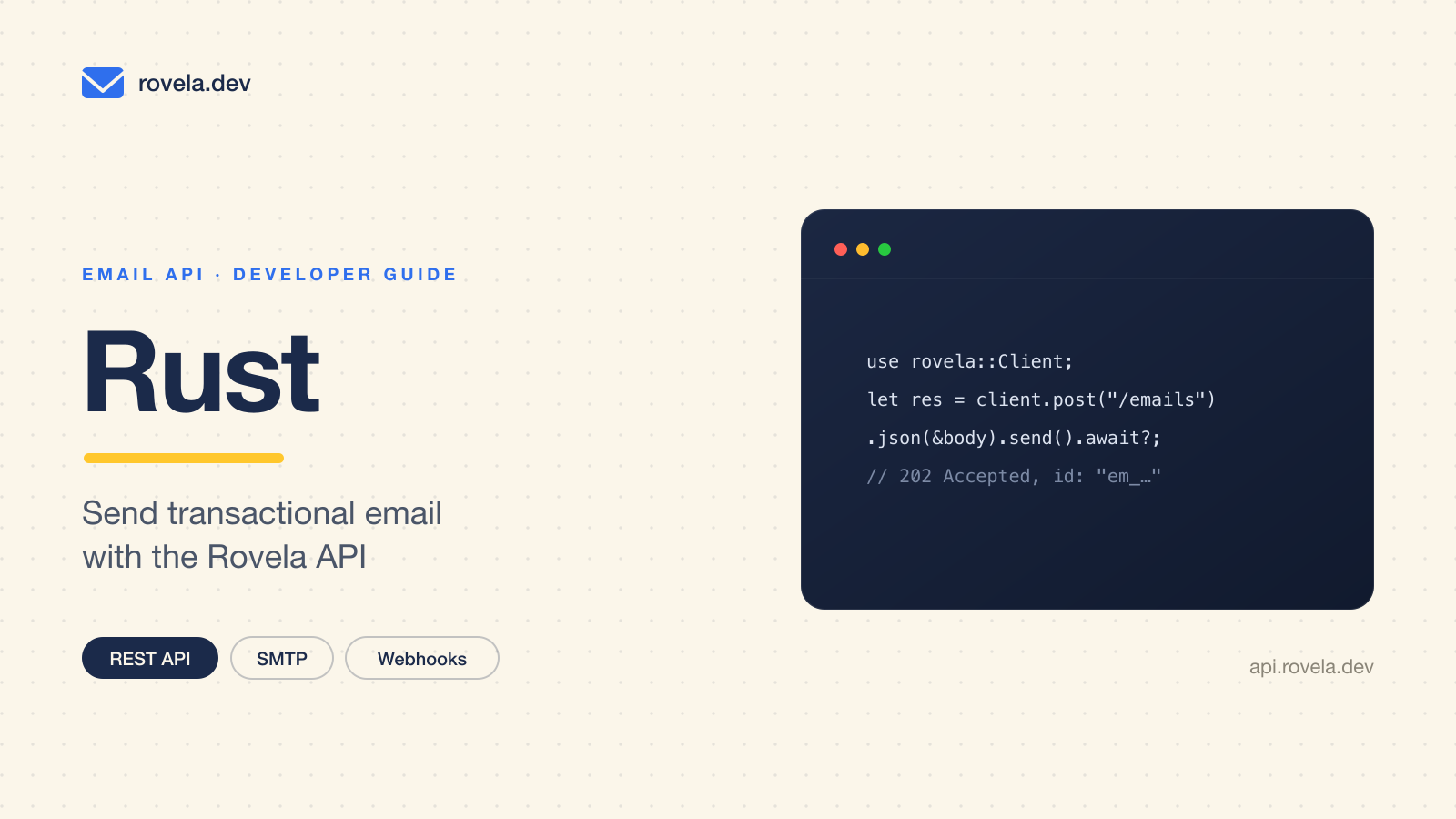
Send transactional email from Rust with reqwest and the Rovela HTTP API, run concurrent sends behind a semaphore, retry with idempotency keys, attach files, relay over SMTP with lettre, and verify webhook signatures with HMAC.